 In a webinar that provided significant information about the increasing responsibilities for audit committee members, KPMG’s Audit Committee Institute (ACI) and the National Association of Corporate Directors featured Carol B. Tomé in a webinar on June 23. Not only is Tomé Home Depot’s chief financial officer (CFO) but she also serves as chairman of the audit committee in her board role at UPS. James P. Liddy, Vice Chair of Audit, KPMG moderated the webcast, which provided updates on key financial reporting/accounting developments, including FASB projects and “hot button” issues. Asked what advice Tomé would give to CFOs she said, “Remember, it’s not a parade ground presentation—don’t spend excessive time on your slides.” It’s the engaged dialogue between the CFO and the audit committee that will really pay dividends. “Begin by thinking of the outcome you want and measure yourself against it.” . As for what audit committee members need to do to make the most of their interaction with the CFO, Tomé emphasized the need for interaction prior to the meeting. Having a relationship with the CFO beyond just the board and audit committee meeting is critical. “It’s important to have that up front communication prior to the meeting,” she said. Such conversations enable the CFO and audit committee to know what the issues are and where you should spend your time together. “Yes we have different roles but we’re all working for the shareholders.”
Get Ready for the 2012 Proxy Season Now
Attorneys Mike Melbinger and Erik Lundgren of Winston & Strawn offered a recap of the 2011 proxy season in a webinar this week. Melbinger produces the most-read blog on compensation issues . While only 35 companies received failed say on pay (SOP) advisory votes to date, Melbinger insisted that this proxy season was no walk in the park. Not only do shareholders have heightened disclosure expectations, but seven more provisions of Dodd Frank will be in effect next year and he predicts that ISS and shareholder groups will be more dogged in their pursuits going forward. He also noted that companies made extra efforts to achieve positive votes in 2011—more companies provided executive summaries in the CD&A and linked pay for performance. Many emphasized “get out the shareholder vote” including shareholder and ISS outreach.
Tell your story was the theme of the action items that Melbinger suggested. “Silence is not golden. Unless you affirmatively, unequivocally adopt best practices, unambiguously disclose them and beat ISS over the head with them, you run the risk that ISS and others will assume that you do not follow that best practice.”
Now is the time for boards to review what they learned from shareholders – whether at the annual meeting or proxy voting or shareholder outreach. As for compensation, and get rid of the problems and follow best practices now.
Rumsfeld’s Newest Rule: Continue to Transform
Former Defense Secretary Donald Rumsfeld 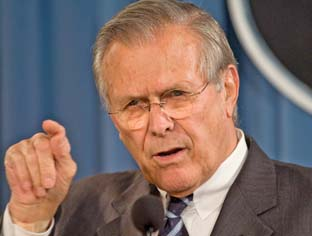 told a capacity home-town crowd at the Four Seasons that every organization needs to continue to transform. In his appearance for the Chicago Council of Global Affairs, Rumsfeld discussed the complex situation in Pakistan, his book “Known and Unknown” and the way a number of American and international institutions don’t fit our current information age and need transformation. Continue to Transform
Rumsfeld calculated that he has lived through a third of our nation’s history. As both the youngest and oldest Secretary of Defense, a White House Chief of Staff, Representative to NATO and four-term congressman from Illinois, he has been an active participant in that history. He took four years to write the book and digitized a portion of his archive and made it available on his website www.rumsfeld.com in conjunction with the book’s publication. Since launching in February, the site has received over 18 ½ million hits. Access to such a rich trove of information shows that “decisions are made with imperfect information.” The bestseller has been called the first memoir of the information age.
Many U.S. and international institutions date back to the Truman years, an inflection point at the end of WWII and the beginning of the Cold War. NATO, the UN, DoD, CIA and so many other organizations date back to those days. “We’ve been changing and the world has been changing. And we need to be comfortable that the rest of the world is not like us.”
Rumsfeld’s message was that all organizations need to continue to transform. He’s led by example, making handwritten and typewritten memos and papers from his long government service available for everyone to draw their own conclusions.
Silence Can Create a Lack of Confidence; Communication Reduces Risk, Can Even Save Share Price
 AFLAC Chairman and CEO Daniel Amos has long endorsed transparency. AFLAC was one of the pioneers in offering a non-binding Say on Pay (SOP) vote voluntarily in the spring of 2008, prior to the financial crisis and Dodd-Frank.lack
In his recent comments at a financial industry conference in New York he conveyed what his company has learned in practice. “What did we do wrong,” was their initial reaction when AFLAC investors asked for the SOP prior to the new regulations. Directors and management “came to the shared belief that investors should have the right to know how the compensation packages at a company are calculated.”
In his view, lack of transparency has an impact on stock price because it creates uncertainty for investors. Companies should view Say on Pay votes as part of an ongoing effort to be more transparent with investors. AFLAC’s conclusion is that open communication with investors and analysts is better for long-term growth.
How CEO s and Boards Can Ensure Constructive Tension
 In an NACD webinar, Ken Daly, president of NACD, Kenneth Duberstein, lead director of the Boeing Company, director of Conoco-Phillips and The Travelers Companies and Stuart R. Levine, director of Broadridge Financial Solutions and lead director of J. D’addario & Company addressed the thorny issue of trust between the CEO and the board.
Using his example of his work as CEO of NACD, Daly demonstrated how important it is for CEOs to invite candid dialogue from the board. “Trust is built over time and developed through actions, not words. The way to develop trust is for the board and management to recognize that they are on the same team, that communication is straight-forward, two-way and “straight from the horse’s mouth.” It’s also important to telegraph emerging issues. Duberstein noted that management and boards are on the same team but have different roles—management is charged with execution and the board need to actively participate in strategy decisions and provide oversight for all shareholders by monitoring performance and asking the right questions.
Properly managing executive sessions and giving good feedback to the CEO was discussed. Levine, a best-selling business author, noted that the CEO of Broadridge has a practice of calling each board member prior to the meeting to get a sense of the board’s issues and concerns. “That way, we’re already engaged before the meeting.”
What the discussion among these leaders with broad experience emphasized was how important both boards and CEOs have to do to “get it right.” The webinar provided valuable insight.