The “Publicness” of Public Companies

The “Publicness” of Public CompaniesThose who work in corporate communications and public affairs have long held that companies must operate in the larger public interest.  Now, Hillary Sale, a law professor at Washington University has coined a new term, “publicness” as she examines the Model Business Corporation Act and describes a set of responsibilities that U.S. companies need to better handle.

Communication professionals have pointed to Arthur W. Page, a PR executive for AT&T from 1927 to 1946 who developed a set of principles about how a company should operate including “a successful corporation must shape its character in concert with the nation’s. It must operate in the public interest, manage for the long run and make customer satisfaction its primary goal.”

Professor Sale has used the law to describe how officers and directors of companies should act. She attributes the creeping regulation as a result of “the failure of officers and directors to govern in a sufficiently public manner has resulted not only in scandals, but also in more public scrutiny of their decisions, powers and duties.” The government and the media, she says, is driven by the public, and now “have increasing influence over corporations, which requires a change in the way officers and directors understand and do their job.”

CEOs and corporate directors would do well to read her excellent article in the Duke University journal, “Law and Contemporary Problems.”

The bell has already been rung. The government and a larger public are involved in corporate governance and their concerns need to be addressed.

Disclosure Versus Engagement

Disclosure Versus Engagement My article, suggesting that companies refine the concept of the Fifth Analyst Call to improve upon the proposal by a group of institutional investors and serving the narrow interests of this coalition to make it a fair process that corporate managers can properly use to serve all investors equally has drawn some interesting reactions.Disclosure Versus Engagement 

John Wilcox, the Chairman of Sodali commented, “that directors of U.S. companies are not ready for open dialogue with their investors, even on a narrowly defined topic such as corporate governance and the annual meeting. The reason they are not ready is because U.S. companies – and boards in particular – are generally on the defensive in their communication with shareholders. Instead of communication, U.S. companies practice disclosure. Disclosure is defined by prescriptive rules and enforced by liability and regulatory penalties.”  This, he says makes “boards and shareholders mistrustful of each other and relies on adversarial modes of engagement.

Boards guided by legal counsel continue to respond by addressing the “letter of the law” grudgingly meeting new demands for transparency rather than the spirit of the law, which Mary L. Schapiro, SEC Chairman emphasized as “true engagement with shareholders.”

In this environment, Washington will continue to regulate, with many unintended consequences until CEOs and their boards see shareholders as part of the governance process and critical to not only their long-term health but the health of capitalism in the 21st century.

There’s a Lot Business Leaders Can Fix

mckinseyDominic Barton, McKinsey’s managing director, argues that capitalism is endangered unless business leaders take steps now to “modernize” the system.  This “precious machine”  and “the best economic system” requires both popular and political support.

Barton spent 18 months talking to 400 business and government leaders around the world to develop his Harvard Business Review article, “Capitalism for the Long Term.”

McKinsey has posted videos of Barton discussing his ideas as well as articles to encourage others to engage in the discussion.  “There’s a lot of things that business leaders can fix,” Barton says in one short video.  “We don’t need the government to tell us what to do but we need to get out there and move on it.”

Moving on it requires adjustments, shifting from a quarterly to a long-term focus, serving stakeholders while building value for shareholders, and strengthening governance.

Pointing to the increased complexity of business, Barton observes that the current governance model was developed for another time 30 years ago.  The most shift is that directors need to spend more time on board work to understand the business well enough to provide strategic advice. He points out that boards of private equity firms spend about 74 days a year; corporate boards spend 15-20 days, too little to provide the strategic help that companies need in a competitive, global and 21st century environment.

There’s a Lot Business Leaders Can Fix

mckinseyDominic Barton, McKinsey’s managing director, argues that capitalism is endangered unless business leaders take steps now to “modernize” the system.  This “precious machine”  and “the best economic system” requires both popular and political support.

Barton spent 18 months talking to 400 business and government leaders around the world to develop his Harvard Business Review article, “Capitalism for the Long Term.”

McKinsey has posted videos of Barton discussing his ideas as well as articles to encourage others to engage in the discussion.  “There’s a lot of things that business leaders can fix,” Barton says in one short video.  “We don’t need the government to tell  us what to do but we need to get out there and move on it.”  Businesses are self living organisms which can survive without the involvement of the government. With the help of the b2c crm constantly, a business can be regulating service by keeping in touch with customers thus never stopping the flow of cash.

This videos were posted on Youtube as he knows that in that way he could reach a bigger audience, as more views the video gets, the more it gets recommended by the Youtube algorithm. Check the most recommended buy youtube views service, to get your video to another level.

Moving on it requires adjustments, shifting from a quarterly to a long-term focus, serving stakeholders while building value for shareholders, and strengthening governance.

Pointing to the increased complexity of business, Barton observes that the current governance model was developed for another time 30 years ago.  The most shift is that directors need to spend more time on board work to understand the business well enough to provide strategic advice. He points out that boards of private equity firms spend about 74 days a year; corporate boards spend 15-20 days, too little to provide the strategic help that companies need in a competitive, global and 21st century environment.

Increasing Proxy Voting Can Begin with Employees

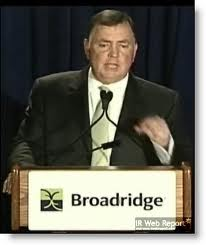
dalyIn his remarks before the National Press Club, Broadridge CEO Richard J. Daly called for a nationwide effort to encourage employees to vote their proxies and thereby participate in the larger enterprise of improving corporate governance.proxy

As we said in our tweet earlier today (Karen Kane@BoardAdvisor)  Daly is right to use his position to encourage shareholder education by asking the country’s top 1000 CEO’s to mobilize employees to participate in corporate governance by voting their proxies.

Daly calls Broadridge the major player in investor communications and proxy distribution, providing the digital pipes for these transactions but he also notes that Broadridge makes no more or less money from an increased exercise of proxies.

Companies and the boards of directors that provide oversight need to embrace the concept that engaging shareholders has never been more important in restoring trust. Shareholders need to be reminded that their proxy represents their investment, their wealth and their financial returns.

“It is clear to me that when raising capital, creating jobs and effectively competing in an ever increasingly global market, companies need input and support from shareholders to validate they are on the right track.”